Mentoring at CYOT: Reflections on Structure, Continuity, and the Future of Learning
Recently, I participated in a progress and impact review meeting for CYOT (Honghu Youth), a nonprofit organization supporting young people as they navigate education and early career decisions. Over the past cycle, I served as a mentor to three students. What stayed with me was not only their individual growth, but how thoughtful structure and collective effort can quietly reshape opportunity.
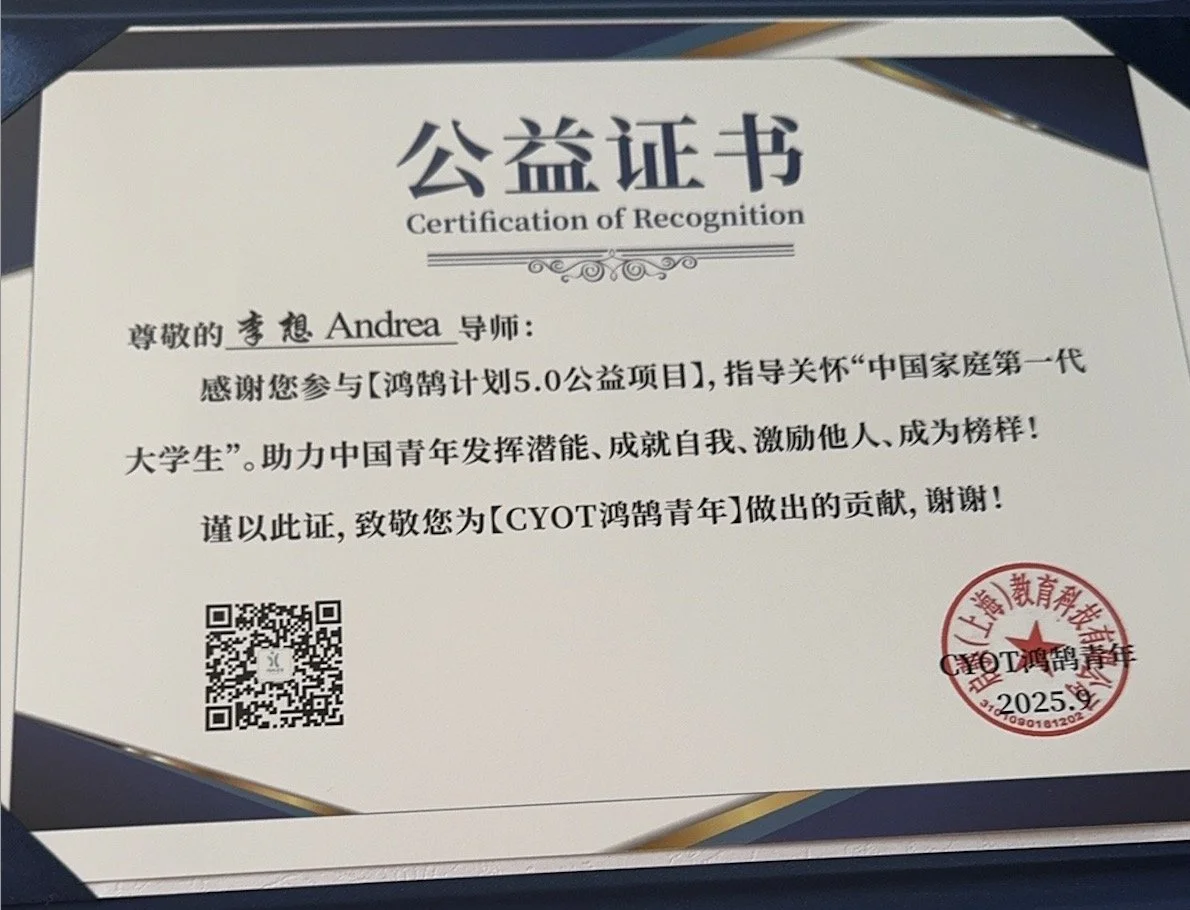
Over the past five years, CYOT has grown from a small group of just over 30 mentors into a community of more than 380 volunteers, supporting over 500 students. In 2025, the organization entered a period of transformation, refining its identity, structure, and long-term direction. Its flagship initiative, the Honghu Program, now in version 5.0, places mentors at the center of its design. Students engage with multiple mentors across stages, allowing them to encounter diverse perspectives rather than depend on a single authoritative voice.
The program combines practical preparation with reflection. Core modules include professional email writing, career exploration, and reading, alongside structured mock interviews and, more recently, AI-assisted interview simulations. These designs respond to a clear reality: many students face not a lack of ability, but a lack of information, confidence, and informed guidance when making critical decisions. Data shared during the meeting reflected this clearly—most participants come from non-elite educational backgrounds and experience significant uncertainty at the transition from school to work.
What moved me most were the students’ reflections. Several shared how mentorship helped them break through information barriers, reframe anxiety, and begin viewing their careers as evolving processes rather than fixed outcomes. One student later chose to return as a volunteer, a small but powerful sign that support, when done well, can become generative rather than extractive.
Looking forward, I increasingly believe that organizations like CYOT play a stabilizing role in the future of education. As formal systems struggle to respond quickly to social change, flexible, community-driven NGOs provide continuity, trust, and human-scale support. When these structures grow stronger and more numerous, education becomes more resilient. Within this ecosystem, AI has the potential to amplify—not replace—human mentorship: extending access, supporting reflection, and scaling care without erasing judgment. Education’s future, I believe, will be shaped not by technology alone, but by how thoughtfully we embed it within humane, participatory systems that allow learning to endure.
